Nervous System 101 ™
A Whole Nervous System Foundation for Trauma & Chronic Stress
A whole nervous system foundation for trauma, chronic stress, and attachment wounds — grounded in somatic psychotherapy and nervous system science.
with Shalini Cameron, Somatic Psychotherapist
Not understanding your nervous system is exhausting.
It can leave you questioning yourself, your body, and whether real change is even possible.
I know this place well — not just professionally, but personally.

When you understand your nervous system, your experiences start to make sense. Instead of feeling confused by your symptoms or reactions, you start to see clear patterns- how your body responds to stress, threat and safety over time.
Rather than fearing what’s happening in your body, you understand why it’s happening. That understanding alone can reduce fear, soften self-judgment and support a clearer direction towards safety in yourself, relationships and the world around you,
You may have worried that you’ll never fully heal, or that something is fundamentally wrong with you.
You may have noticed the same emotional patterns repeating — in yourself, in relationships — even when life looks calmer on the surface.
You may feel overwhelmed, reactive, or shut down, and judge yourself for not coping “better”
You may have tried therapy, mindset work, or coping strategies but never fully explained what your body was doing in moments of stress or connection.
If this feels familiar, you are not failing.
You’ve simply never been given a clear, accurate understanding of your nervous system — and how it shapes your sense of safety in yourself, in relationships, and in the world. Without that understanding, change can feel confusing or out of reach.
Understanding your nervous system is the first step toward feeling safer — internally and relationally.
Imagine if things finally made sense…
-
You understand own your reactions instead of judging yourself for them.
-
Stress and trauma make sense as learned nervous system patterns -not as something wrong with you..
-
You have a clear understand of your own patterns, own reactions and a grounded direction for healing.
Nervous System 101
A Whole Nervous System Foundation for Trauma & Chronic Stress.
A whole nervous system foundation for trauma, chronic stress, and attachment wounds — grounded in somatic psychotherapy and nervous system science.
The Structure
Start with Class 1 | | Your Nervous System Explained.
Continue with Class 2 | Survival States Explained.
Deepen with Class 3| Trauma & Stress in the System.

One class leads to the next….
Class One gives you the map…
Class Two shows you how the system moves within it…
Class Three explains how stress and trauma have shaped the terrain…
In Class 1 you will learn..
Why the nervous system is so important in healing.
Why the nervous system is the foundation of healing. The order of healing using the nervous system pyramid / ladder. Why nervous system education has been the missing piece for so many people.
What is the nervous system.
The basic structure of the nervous system and its main branches. An introduction to the autonomic nervous system, including the vagus nerve. An introduction to neuroception (how the body detects safety and threat). A brief overview of survival responses (fight, flight, shutdown).
Your nervous system can change
The science that the nervous system can rewire. How rewiring and neuroplasticity actually work (in simple terms). Why this matters for healing and recovery
In Class 2 you will learn..
The Survival States
The three core nervous system states: safety, fight/flight, and shutdown. What each survival state feels like in the body and mind. Why these states exist and how they function to protect you
How Your Nervous System Responds
How the nervous system detects safety and threat automatically. What neuroception is and how it shapes your reactions. Why responses happen before conscious thought
Survival States in Everyday Life
How the nervous system detects safety and threat automatically. What neuroception is and how it shapes your reactio. Why responses happen before conscious thought
In Class 3 you will learn..
Different Types of Trauma
The three main types of trauma: acute, chronic, and developmental/complex.. How each type impacts the nervous system differently. Why trauma is defined by nervous system overwhelm, not the event itself
Trauma Responses in the Body
How trauma shapes fight, flight, freeze, shutdown, and collapse responses. Why reactions can persist even when life feels safer now. How trauma responses show up as anxiety, numbness, reactivity, or disconnection
Capacity, Stress, and Change
How trauma and chronic stress reduce nervous system capacity over time. What allostatic load is and how it affects the body. Why trauma responses are adaptive — and how change becomes possible
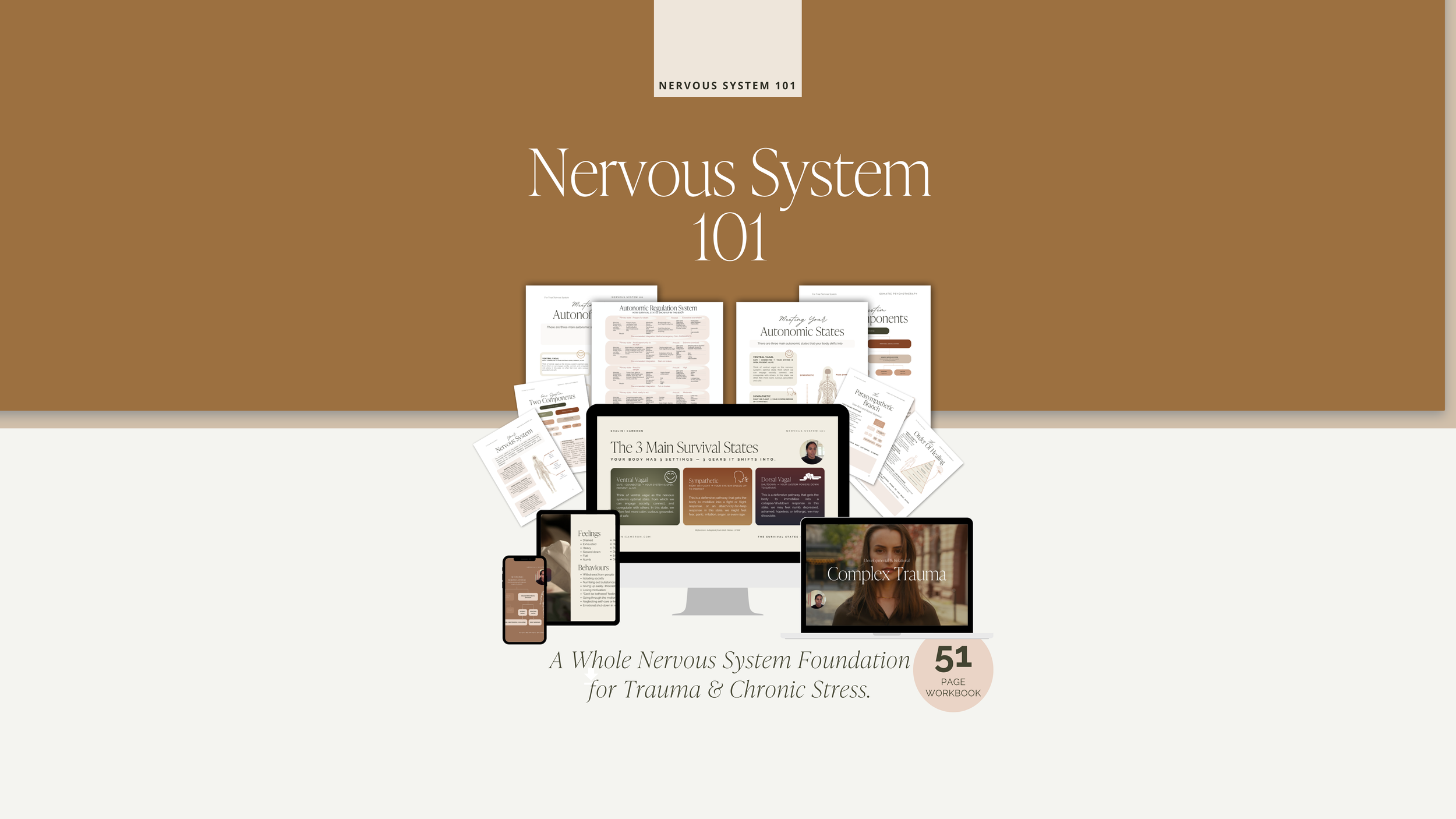
Includes
Somatic Check In Videos
Resources & Research
Workbooks
CPD Certificates
How The Series Is Taught
-
A Visual Nervous System Guide and Workbook
This class is supported by a clear, visual workbook designed to make the nervous system understandable — not overwhelming. Rather than long explanations, you’re guided through simple maps and diagrams that show what your system is doing and why. It’s a grounding reference you can return to whenever your body feels confusing or reactive. -
Grounded, Paced teaching
The teaching is slow, clear, and intentionally paced. Each concept builds gently so your system can absorb the information without overload. There’s no jargon, no academic language, and no pressure to “get it right.”
-
Designed for Overwhelmed Systems
Everything about this class is created with dysregulated systems in mind.Calm visuals. Spacious layouts. Simple, precise language.Learning here is meant to feel stabilising — not demanding. -
Lifetime Access
You can move through the material at your own pace. Return whenever you need to re-orient, remind yourself what’s happening, or come back to the bigger picture.This is foundational learning — and it’s yours to keep.

Would you prefer to purchase them separately?
Each part builds off the information of the previous section, if you wish to build together
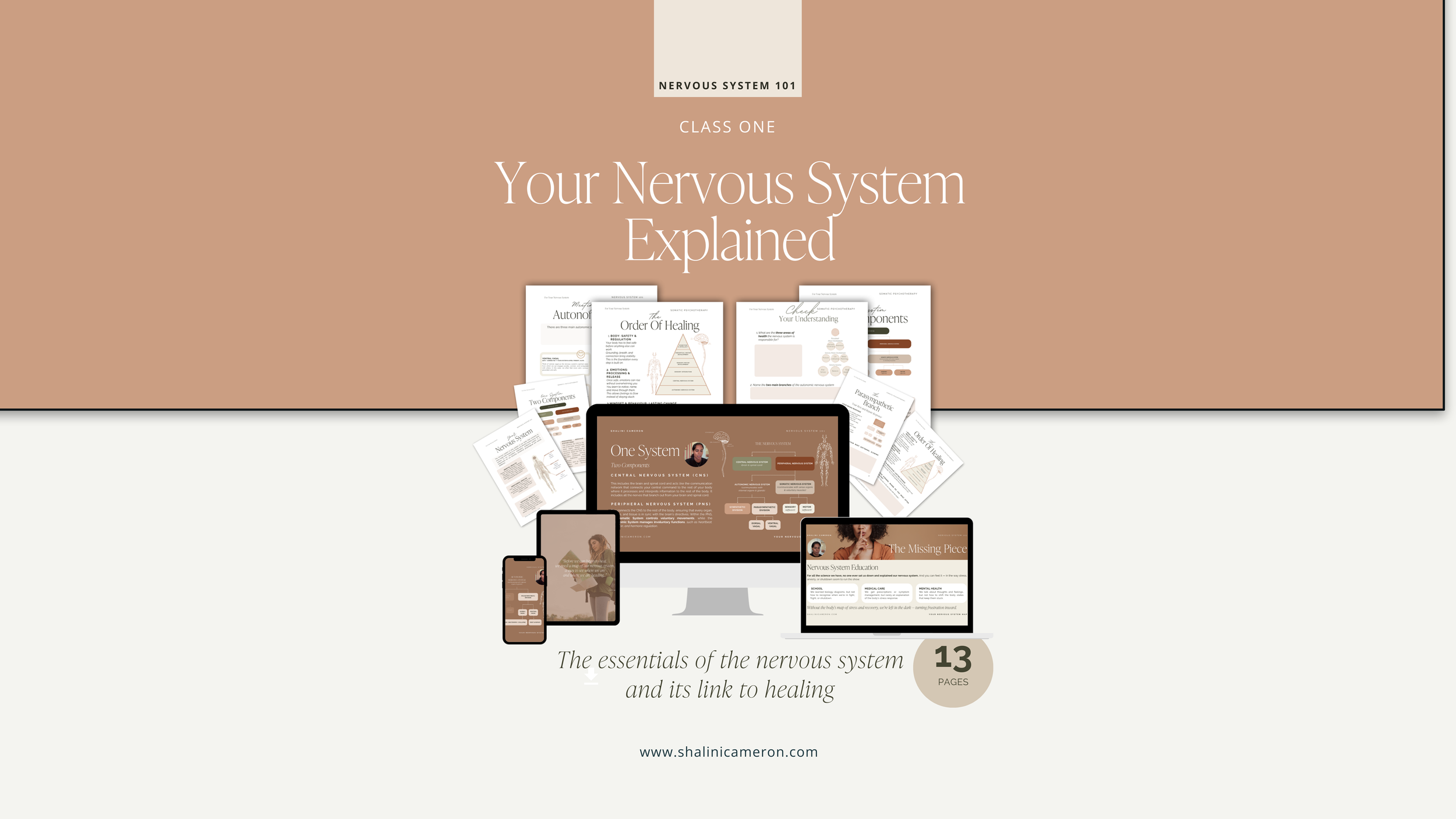
PART ONE
Your Nervous System Map
Understand how the nervous system works and what it is organised around.
his class lays the foundation by helping you understand how your nervous system works, how it is organised, and why your body responds the way it does. You’ll learn how stress, safety, and past experience shape your reactions over time, so anxiety, shutdown, or overwhelm stop feeling random. This class provides the essential map everything else builds on.
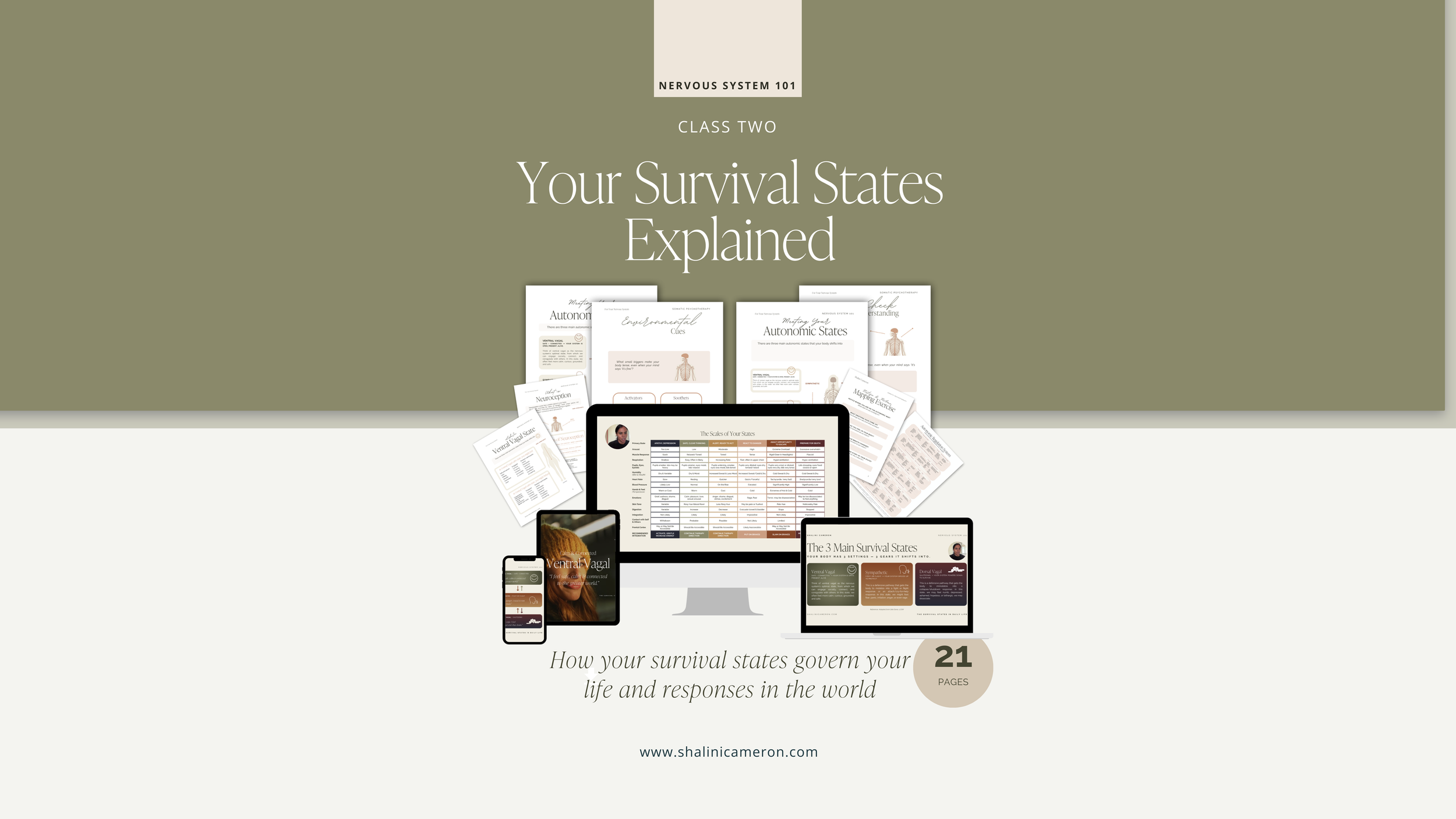
PART TWO
Survival States in Daily Life
Recognise how nervous system states shape behaviour and patterns and how we can change our state, that changes our story.
This class focuses on how nervous system survival states show up in everyday life — in behaviour, patterns, relationships, and decision-making. You’ll learn how fight, flight, and shutdown operate automatically, why certain responses repeat, and how recognising your state can change how you relate to yourself and others.
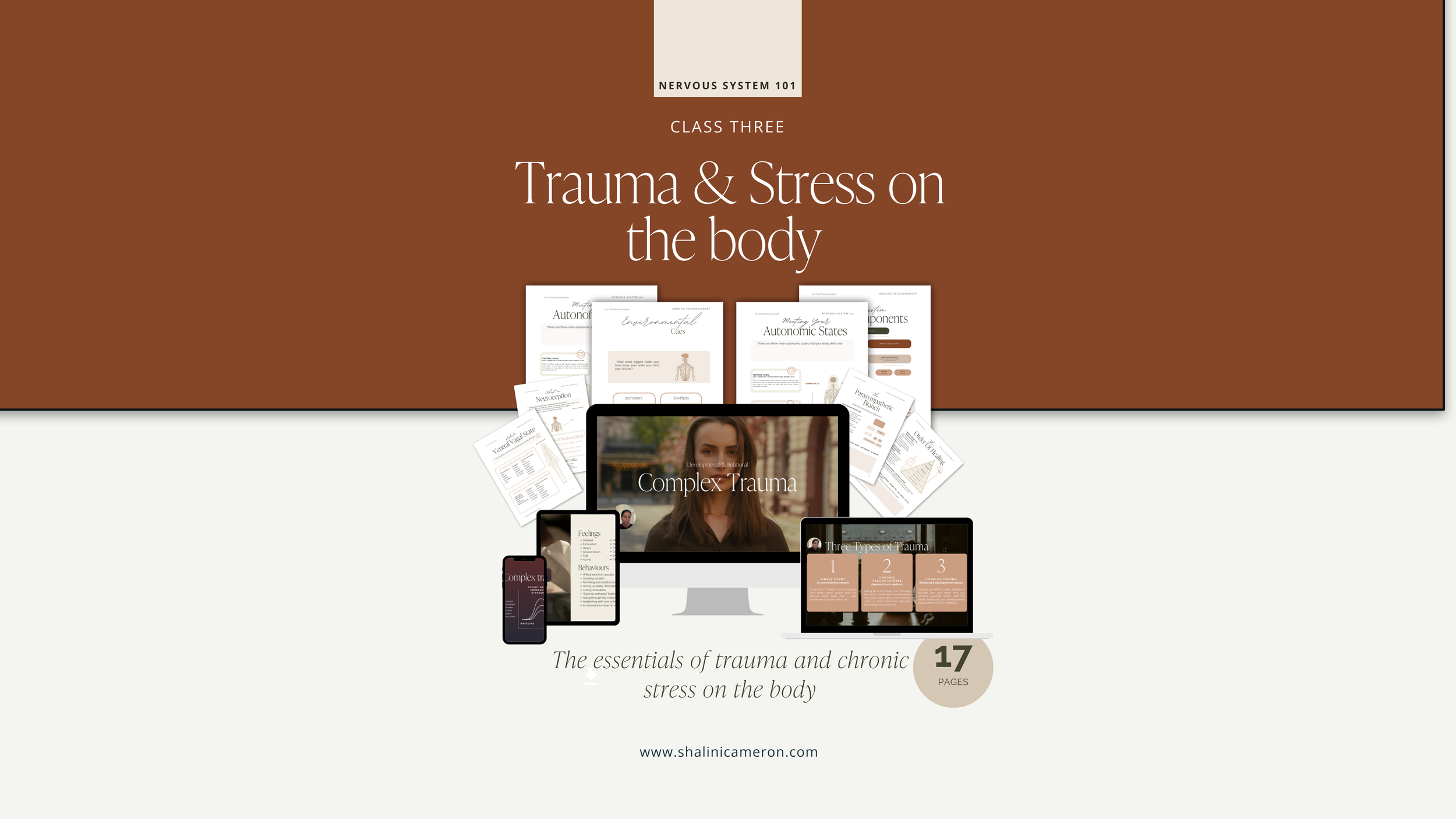
PART THREE
Trauma & The Nervous System
Understand how long term stress and the trauma of all types shapes capacity, systems and recovery.
This class explores how trauma and chronic stress shape the nervous system over time, influencing capacity, patterns, and recovery. You’ll learn how different types of trauma impact the body, why responses can persist long after danger has passed, and how understanding your patterns helps you know what your system needs to feel safer and more regulated.
Taught from a trauma-informed, nervous-system-led perspective grounded in clinical understanding and years of working with overwhelmed systems.
This course focuses on helping you understand how the nervous system responds to stress, threat, and experience — and why those responses make sense. This class is educational and trauma- informed. It supports understanding of the nervous system physiology and stress responses. It is not a substitute for medical or mental health care.


After completing Nervous System 101, you will have:
-
A clear understanding of why your body responds the way it does across anxiety, shutdown, overwhelm, and reactivity.
-
Language for your experience so your patterns make sense without blame or self-judgement.
-
The ability to recognise survival patterns in daily life and understand when your nervous system is protecting you.
-
A grounded framework for working with your nervous system without forcing, fixing, or overriding your body.
-
An understanding of how stress and trauma shape capacity over time and why past experiences still influence the present.
-
Clarity about where you are and where to begin so you can stop guessing and start in the right place.
“Would this work for me?”
Here’s what some of my students have to say after this class.

“As a therapist, I’d studied the nervous system and thought I had a solid grasp. But this class helped me actually connect the dots in a way textbooks and training never did. It was clear, practical, and—most of all—gentle. I found myself saying, ‘Ah, so that’s why my body reacts the way it does.’ Even with years of knowledge, I felt genuine relief and a new sense of compassion for both myself and my clients. Shalini has created something magnificent here, detailed , thorough and so digestible. Every practitioner should have this foundation.”
— HANNA TRUU- THERAPIST
“WOW! Amazing! Ive learnt so much I never knew , I wish I knewthis earlier I thought something was just wrong with me. Therapy, breathing, meditation—nothing really made a dent. This class finally explained why my body reacts the way it does. For the first time, I stopped blaming myself—I actually felt relief! Now, I finally understand what’s going on inside me.”
— KATE MEREDITH- PT INSTRUCTOR
“Every other program gave me tools to ‘fix’ myself, but always left me feeling confused and frustrated. This was the first time someone explained what’s actually happening in my body—without making me process my past or perform. It was that missing piece nobody ever gave me. Everything just makes sense now.”
SARAH LYNNE
Who is this for?
This series is for you if:
You feel anxious, overwhelmed, reactive, shut down, or emotionally flat — and want a real explanation.
You’ve tried mindset work or coping tools, or ‘calming’ techniques, but your body still reacts under stress.
You want to understand what state your nervous system is in and why your reactions make sense.
You’re tired of blaming yourself and want clarity instead
You want a solid, grounded foundation before doing anything deeper
This class is especially supportive if you’ve been told what to do -but never taught what’s actually happening inside your body.
Who this is NOT for?
This class may not be the right fit if:
You’re looking for a quick fix, hack, or “calm down in 5 minutes” solution
You want trauma processing, emotional release work, or therapy-style exploration
You believe the answer is simply to “try harder” or “think differently”
You want a highly technical neuroscience course with heavy academic language.
You’re not open to slowing down and learning how your system works first.
This class doesn’t push change- it creates the conditions for change.
This series is the foundation.
When you understand your nervous system, nothing you experience feels random anymore. Your reactions make sense. Your patterns have logic.
And change finally has somewhere to land. Every form of healing builds on this.
FAQ
-
Because the nervous system doesn’t change through instruction — it changes through felt safety and accurate information.
If your system doesn’t understand what’s happening, it stays vigilant.
This class gives your system orientation. That alone reduces threat.
As a psychotherapist, I see this again and again: when people finally understand why their body reacts the way it does, their system softens without effort.
-
Most online content gives fragments — tips, tools, or simplified explanations.
This class gives you a coherent map.
Instead of collecting more techniques, you learn:
• how the system is organised
• how it decides between safety and threat
• why certain patterns repeat even when “life is fine”
This kind of understanding creates stability, not dependence on tools.
-
Yes — and there’s nothing wrong with you.
Many people feel:
• relief
• sadness
• validation
• or a quiet sense of “oh… that explains so much”
That isn’t overwhelm. That’s your system recognising itself. You are not being pushed into anything. You can pause, step back, or return later.
-
This class does not replace diagnosis or therapy — but it reframes them.
You’ll learn how many symptoms are nervous system responses, not personal failures or permanent traits.
For many people, this is the first time their experience has been explained in a way that feels accurate and kind.
-
Will this bring up the past?
The class does not guide you into memories or emotional processing.
However, understanding the nervous system often brings clarity about why certain experiences affected you the way they did.
If something arises, that’s information — not something you have to fix or push through.
-
Then this class is especially important. When a system has been under stress for months or years, jumping straight into “regulation” or “healing work” can feel destabilising.
This class is about orientation first — helping your system understand where it is and why.
Safety comes before change.
-
Yes. It was designed with that in mind. The pacing, language, and structure are intentionally chosen to support sensitive systems.
Nothing in this class is designed to push, provoke, or activate.
-
There is no right way.
You can:
• watch slowly
• repeat sections
• skip ahead
• come back weeks later
Your nervous system sets the pace — not the course.
-
The most common responses I hear are:
• “I finally understand myself.”
• “I’m not broken.”
• “This explains everything I couldn’t put into words.”
That shift — from confusion to clarity — is the foundation for all real healing.